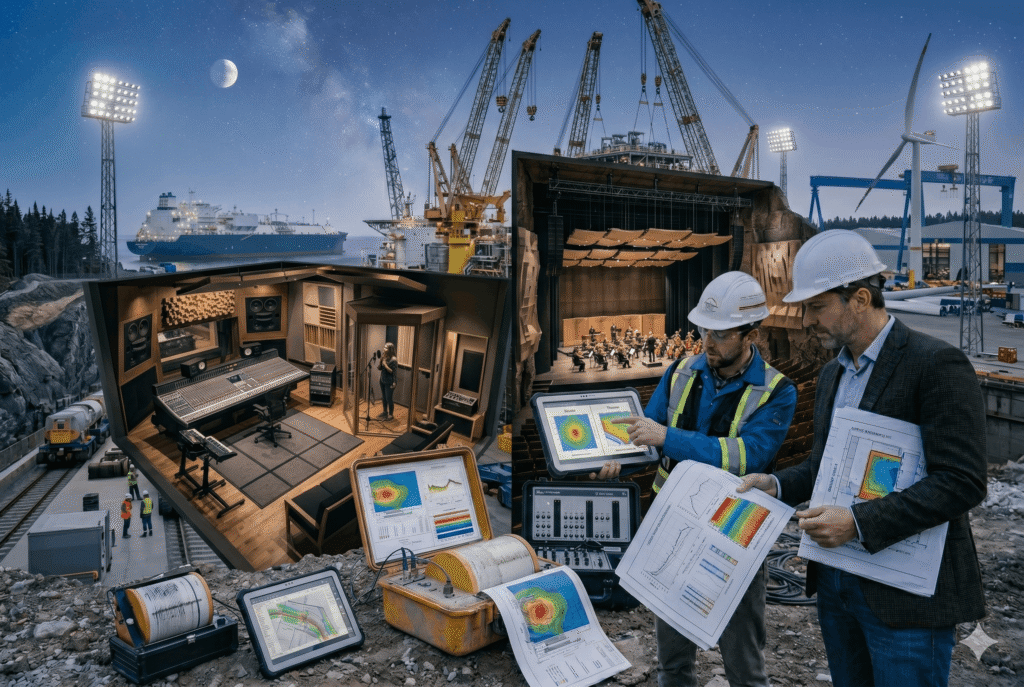

Acoustic performance defines how sound is experienced within a space, but the requirements vary significantly depending on the application. From performance venues to recording environments, each space demands a tailored approach to sound behavior, clarity, and control. Theatre acoustic design focuses on delivering consistent sound distribution to large audiences, while other environments require entirely different acoustic priorities.
Misalignment between the application and acoustic strategy can compromise functionality, leading to poor sound clarity, uneven coverage, or recording inaccuracies. Understanding how acoustic objectives differ between studios and theatres is essential for achieving performance-driven design outcomes.
Why Acoustic Design Must Be Application-Driven
Acoustic engineering is not a one-size approach. Each environment has distinct sound characteristics based on its purpose, occupancy, and operational requirements. The design strategy must account for how sound is generated, transmitted, and perceived within the space.
In performance venues, sound must travel evenly across large areas without distortion. In controlled environments such as recording studios, sound must be isolated, refined, and accurately captured. These differences shape material selection, room geometry, and acoustic modeling approaches.
Studio Acoustic Design: Precision and Control
Studio acoustic design prioritizes accuracy and isolation. Recording and broadcast environments require controlled acoustics to ensure that sound reproduction is free from external interference and internal distortion.
This involves minimizing reflections, controlling reverberation, and eliminating background noise. Acoustic elements such as absorptive panels, bass management systems, and isolation assemblies are carefully positioned to create a neutral listening and recording environment.
The objective is to maintain clarity and consistency, allowing sound engineers to capture and reproduce audio without unintended coloration. Even minor acoustic inconsistencies can impact recording quality, making precision a defining requirement in studio environments.
Theatre Acoustic Design: Clarity and Distribution
In contrast, theatre acoustic design is centred on sound projection and audience experience. The goal is to ensure that speech and music are clearly heard across all seating areas, regardless of distance from the stage.
This requires balancing reflection, absorption, and diffusion to support natural sound reinforcement. Early reflections are often used to enhance clarity, while excessive reverberation must be controlled to avoid muddiness.
Architectural features such as ceiling geometry, wall surfaces, and seating layouts play a critical role in shaping acoustic performance. The design must also account for varying audience sizes and occupancy conditions that influence sound behavior.
Key Differences in Acoustic Strategy
The primary distinction lies in how sound is managed within each environment. Studios require controlled, isolated conditions with minimal variability, while theatres depend on distributed sound energy and spatial consistency.
Reverberation targets differ significantly, with studios aiming for low reverberation times and theatres requiring carefully tuned reverberation to support performance. Material selection also varies, as studios emphasize absorption and isolation, whereas theatres integrate reflective and diffusive elements to enhance sound coverage.
These differences highlight the importance of aligning acoustic design strategies with functional requirements rather than applying generalized solutions.
Integrating Acoustic Engineering into Project Design
Acoustic considerations must be integrated early in the design process to ensure optimal outcomes. Predictive modeling and performance analysis allow project teams to evaluate acoustic behavior before construction, reducing the need for costly modifications later.
Collaboration between architects, engineers, and acoustic consultants ensures that design elements such as geometry, materials, and systems are aligned with acoustic objectives. This integrated approach supports both performance and compliance across diverse project types.
Matching Acoustic Strategy to Project Application
Effective acoustic design depends on aligning the strategy with the space’s intended use. Studios demand precision and isolation, while theatres require clarity and uniform sound distribution. Each environment presents unique challenges that must be addressed through structured engineering analysis and design integration.
Valcoustics Canada Ltd delivers application-driven acoustic solutions for performance spaces, recording environments, and large-scale developments. As a consulting engineering partner, Valcoustics supports projects with data-backed design strategies that ensure reliable acoustic performance. Integrating advanced analysis with tailored studio acoustic treatment, Valcoustics helps deliver environments that meet both technical and operational expectations.
Connect with Valcoustics to align acoustic design with project requirements.