
Selecting the right vessel for pharmaceutical production is a high-stakes procurement decision. Pharmaceutical tanks must meet rigorous purity, structural, and regulatory requirements that standard industrial storage vessels simply cannot satisfy. The factors below are ordered for procurement decisions, guiding engineers and facility managers through the most critical evaluation criteria before committing to a supplier.
1. Introduction to Pharmaceutical Tanks
Fiberglass reinforced plastic vessels deliver superior corrosion resistance compared to metal alternatives, making them a widely adopted choice across pharmaceutical and biotechnology operations. Their non-reactive surfaces protect sensitive formulations from contamination introduced by vessel degradation. Vetting these vessels thoroughly ensures that materials, construction methods, and finish standards all align with the stringent purity and safety requirements governing pharmaceutical manufacturing environments.
2. Vetting Pharmaceutical Storage Tanks
Resin selection is the foundational variable in evaluating pharmaceutical storage tanks. The resin system must align precisely with the chemical formulation profile of the stored substance, including its pH range, solvent content, and thermal exposure. Engineers should review chemical resistance charts specific to the resin grade proposed, confirming stability across the full operating temperature range. Inadequate resin compatibility consistently leads to material degradation, which introduces contaminants directly into the product stream.
Key procurement questions to ask:
- Which resin systems are available, and how are they matched to specific chemical profiles?
- Can the manufacturer provide resistance data for the exact substances being stored?
- What testing protocols confirm resin stability under sustained heat exposure?
3. Inspecting Pharmaceutical Process Tanks
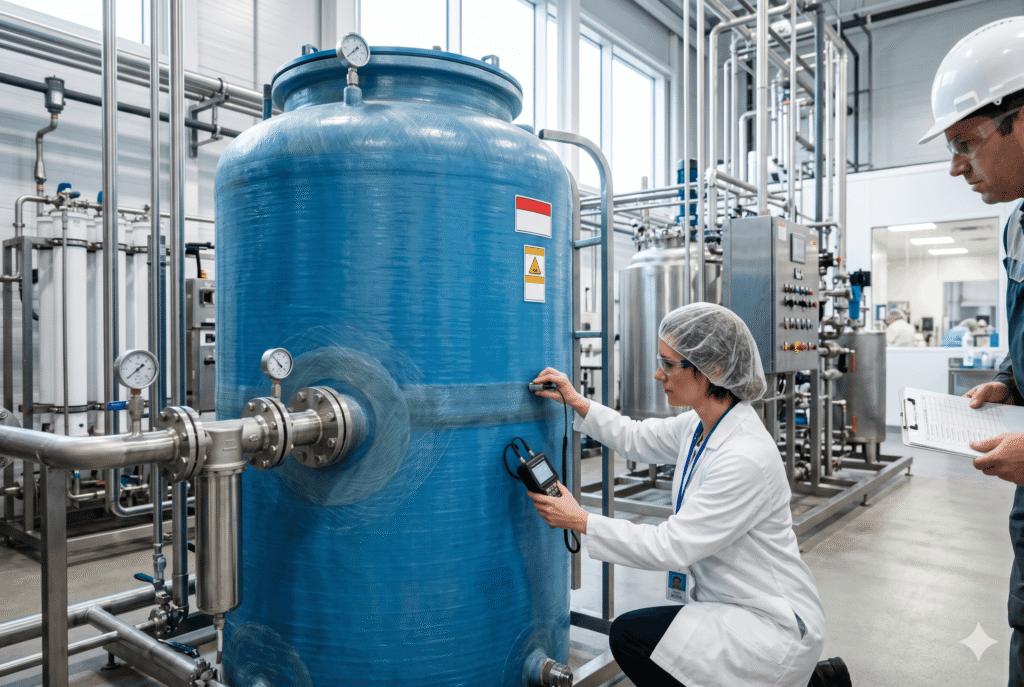
Internal surface finish is a critical differentiator for pharmaceutical process tanks. Rough or porous interior surfaces create sites for microbial colonisation and biofilm formation, both of which pose serious contamination risks between production batches. High-quality liners and smooth laminate finishes facilitate thorough cleaning and support validated clean-in-place or sterilise-in-place protocols. Vetting the interior finish directly determines whether the vessel can meet automated cleaning validation requirements.
- Confirm surface finish specifications meet cleanability standards for the intended process
- Inspect liner continuity for voids, delamination, or surface irregularities
- Verify compatibility between the liner material and cleaning agents used in the facility
4. Verifying High Purity Standards
Materials used in pharmaceutical vessel construction must adhere to recognised industry purity standards, including applicable food-grade and pharmaceutical-grade resin certifications. Documentation packages should confirm that all resins, liners, and ancillary materials meet the regulatory guidelines governing the specific production environment. Certifications from the manufacturer provide traceable assurance of consistent quality across production runs, supporting both internal quality systems and external regulatory audits. Gaps in documentation create compliance exposure that can delay facility qualification.
5. Evaluating Structural Integrity
Fittings, nozzles, and penetrations must integrate seamlessly into the vessel wall to maintain a fully sealed environment, preventing ingress and egress of contaminants or product. Structural calculations should confirm that the vessel design accommodates the specific load imposed by the stored contents, including dynamic loads during filling and agitation. Support systems, including legs, saddles, and platforms, require independent evaluation to prevent mechanical fatigue during sustained heavy-duty operation. Customisable options such as manways, ladders, and domed or flat covers should be reviewed against facility access and safety requirements.
Decision matrix:
- Best for: High-load, high-purity applications requiring sealed, validated environments
- Not for: Applications where structural documentation cannot be provided by the manufacturer
- Cost posture: Higher upfront investment, materially lower lifecycle risk
6. Selecting Belding Tank Technologies Inc.
Belding Tank Technologies Inc. has specialised in manufacturing high-quality fiberglass reinforced plastic tanks since its founding in Belding, Michigan. The company offers standard, field-assembled, and fully custom pharmaceutical tanks, with engineering services including CAD drawings, structural calculations, and technical consultation. Expert consultation helps procurement and engineering teams identify compliant, durable designs matched to unique facility specifications. Contacting the Belding Tank team directly ensures that every vessel, fitting, liner, and support system is configured to meet the exact demands of your pharmaceutical storage or process application.