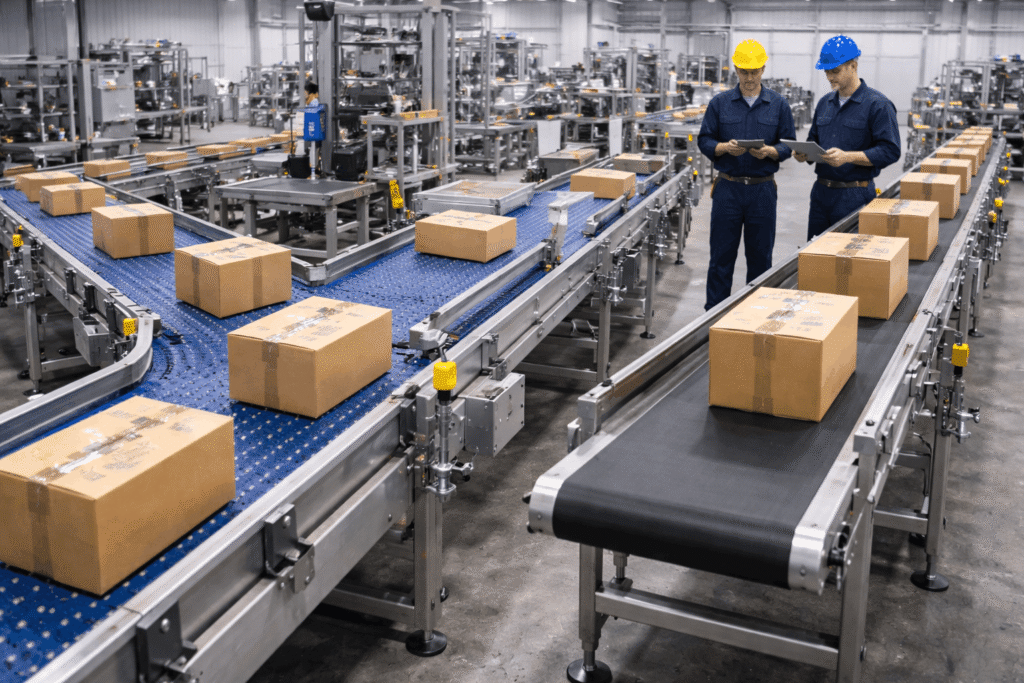

Efficient material handling systems are essential for modern production and packaging facilities. Reliable belt conveyors have supported industrial operations for decades by transporting products across manufacturing, sorting, and packaging environments. These systems remain a foundational solution in many facilities because of their simplicity and consistent performance.
Newer technologies have introduced more advanced capabilities for handling products. One notable development is the use of ARB conveyors, which incorporate specialized roller belt technology that allows products to move not only forward but also sideways across the conveyor surface. This capability has expanded the possibilities for automated sorting, merging, and diverting applications in modern facilities.
Understanding ARB Conveyors and Their Revolutionary Design
ARB conveyors use activated roller belt technology that integrates angled rollers into the conveyor belt surface. As the belt moves forward, the rollers allow controlled lateral movement of products across the conveyor.
This design enables product sorting, diverting, and merging without the need for complex mechanical diverters or multiple conveyor lines. Facilities that require precise product orientation or automated sorting often rely on ARB technology to improve handling efficiency and reduce mechanical complexity.
Traditional Belt Conveyors: Established Solutions in Material Handling
Traditional belt conveyors remain widely used across industries because of their straightforward design and dependable operation. These systems transport products in a single direction using a continuous belt supported by rollers and drive components.
Manufacturing, packaging, and distribution facilities often rely on belt conveyors to move products efficiently across production lines. Their durability and relatively simple maintenance requirements make them a practical solution for many standard material handling applications.
Performance Comparison: ARB Conveyors vs. Traditional Systems
Performance differences between ARB conveyors and traditional belt systems depend largely on the application requirements. ARB systems offer multi-directional product movement, enabling automated sorting, alignment, and diversion within a single conveyor line.
Traditional belt conveyors typically move products in a single forward direction. While this approach works well for many applications, additional equipment may be required when product sorting or directional changes are needed.
Facilities seeking more complex product routing capabilities often benefit from the advanced functionality provided by ARB technology.
Cost Analysis: Investment and Long-Term Value Considerations
Initial investment costs may vary depending on system complexity and automation requirements. Traditional belt conveyors generally have lower upfront costs because of their simpler design and widespread availability.
However, ARB systems can reduce the need for additional conveyors or mechanical diverting equipment. Over time, the ability to perform multiple functions within a single system may contribute to improved operational efficiency and lower overall system complexity.
Application-Specific Advantages: When to Choose Each System
Facilities with straightforward product transport requirements often rely on traditional conveyor systems because they provide dependable, cost-effective material handling.
Applications requiring automated product sorting, orientation control, or multi-directional flow may benefit from ARB conveyors. These systems allow greater flexibility in product handling without requiring complex equipment layouts.
Implementation Considerations for Material Handling Operations
Successful conveyor implementation requires careful evaluation of production requirements, facility layout, and automation needs. Factors such as throughput capacity, product size, and operational efficiency influence system selection.
Facilities considering ARB technology should evaluate system integration, control requirements, and maintenance planning to ensure long-term operational reliability. Careful planning helps ensure the selected system supports efficient product movement throughout the facility.
Selecting the Right Conveyor System for Long-Term Material Handling Efficiency
Selecting the right conveyor system depends on operational requirements, product handling needs, and long-term production goals. Traditional belt conveyors continue to provide dependable solutions for many material handling environments, while ARB conveyors introduce advanced capabilities that support automated sorting and product routing.
Conovey provides advanced conveyor technologies designed to support efficient material handling and automated production environments. Facilities seeking innovative conveying solutions can benefit from Conovey’s engineered systems and custom built conveyors designed to match specific operational requirements.
Connect with Conovey today to strengthen material handling performance and improve production efficiency.