
Production environments rarely remain static for long. Product volumes change, layouts evolve, and automation requirements increase as operations scale. In this context, decisions around conveyor components influence not only how material moves today, but also how easily a system adapts tomorrow. The comparison between modular conveyor components and fixed conveyor parts often comes down to flexibility versus long-term structural stability.
Both approaches serve important roles across manufacturing, warehousing, and distribution facilities. Modular systems emphasize adaptability and rapid change, while fixed systems focus on strength, precision, and permanence. Understanding how these philosophies differ helps operations select conveyor strategies that align with operational realities rather than short-term convenience.
Understanding Modular Conveyor Components
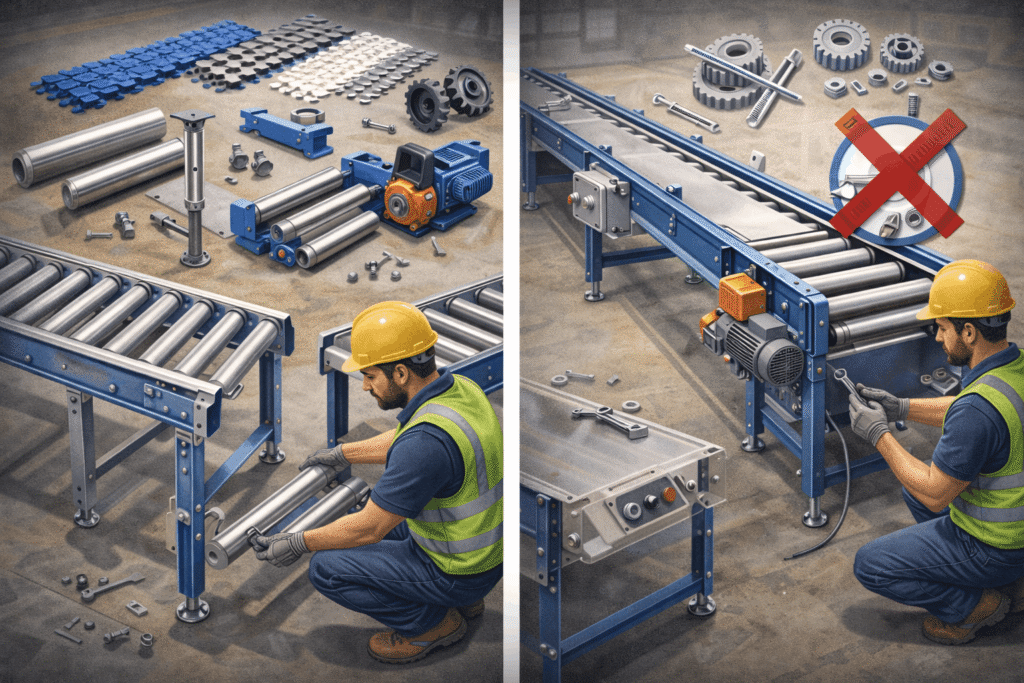
Modular conveyor components are designed as standardized, interchangeable sections that can be assembled, reconfigured, or expanded with minimal disruption. Frames, supports, drives, and accessories use consistent interfaces, enabling systems to scale or change direction without extensive fabrication.
These components are commonly used in systems that rely on belt conveyors, light-duty chain conveyors, and flexible assembly lines where frequent changeovers occur.
Understanding Fixed Conveyor Parts
Fixed conveyor components are engineered for permanent installation. Frames are welded or rigidly bolted, and layouts are optimized for a specific workflow. Once installed, changes often require cutting, re-welding, or replacing major sections.
Fixed systems are typically selected for high-load environments or processes with stable, long-term layouts.
Core Design Philosophy: Flexibility vs Stability
Modular systems prioritize speed of change. Sections can be added, removed, or repositioned with minimal downtime.
Fixed systems prioritize stability and precision. Structural rigidity reduces vibration, alignment drift, and long-term wear in demanding applications.
Installation and Commissioning Differences
Modular conveyor systems are faster to install due to standardized parts and pre-engineered connections. Commissioning timelines are often shorter, especially for phased expansions.
Fixed conveyors require more detailed site preparation and longer installation periods. However, once commissioned, they provide consistent performance with fewer alignment adjustments.
Adaptability to Layout Changes and Expansion
Modular systems excel in facilities that expect frequent layout changes or seasonal reconfiguration. Expansion often involves adding prebuilt modules rather than redesigning the entire system.
Fixed systems are less adaptable but provide optimized performance for established workflows with minimal variation.
Load Capacity and Structural Performance
Fixed conveyor systems generally support higher loads and continuous-duty cycles. Welded frames and reinforced supports distribute stress more evenly.
Modular systems are well-suited for moderate loads but may require additional reinforcement in heavy-duty applications.
Maintenance, Repairs, and Component Replacement
Modular components simplify maintenance. Individual sections can be swapped without dismantling large portions of the line.
Fixed systems may require more extensive downtime for repairs, especially when addressing structural components or embedded roller conveyor parts.
Reliability and Long-Term Stability
Fixed conveyors offer excellent long-term stability due to rigid construction and fewer mechanical joints.
Modular systems introduce more connection points, which require regular inspection to maintain alignment and performance.
Cost Considerations: Upfront vs Lifecycle Investment
Modular conveyors often have lower upfront costs and reduced installation labor. Lifecycle costs depend on how frequently layouts change.
Fixed conveyors typically require a higher initial investment but deliver predictable performance and lower long-term structural maintenance in stable operations.
Integration With Automation and Controls
Both systems integrate effectively with automation, sensors, and control platforms. Modular systems simplify upgrades, while fixed systems support highly precise automation where alignment is critical.
Common Applications for Modular Conveyor Components
Typical applications include packaging lines, assembly operations, distribution centers, and facilities with evolving product mixes.
Common Applications for Fixed Conveyor Parts
Fixed systems are common in heavy manufacturing, high-throughput processing lines, and facilities with established production layouts.
When a Hybrid Conveyor System Makes the Most Sense
Many facilities combine modular sections with fixed frames. This hybrid approach balances adaptability in selected areas with structural stability where loads are highest.
Key Questions to Ask Before Choosing Modular or Fixed Systems
Key considerations include expected layout changes, load requirements, maintenance strategy, and long-term production planning.
Choosing the Right Balance Between Flexibility and Stability
Selecting between modular and fixed conveyor systems requires aligning design philosophy with operational demands. Flexibility supports growth and change, while stability delivers strength and consistency. Conovey engineers conveyor solutions that balance both approaches, delivering systems designed for real-world performance.
Connect with Conovey to build reliable solutions using the right combination of conveyor parts for long-term success.