
Commercial strawberry production has reached a critical turning point. Growers across North America face mounting pressure to increase yields while managing energy costs. The lighting system you choose directly impacts your bottom line, crop quality, and operational efficiency.
Traditional fluorescent grow lights have supported greenhouse operations for decades. However, dynamic LED technology is transforming how growers approach strawberry cultivation. Understanding the differences between these two systems helps you make informed decisions for your operation.
What Makes Strawberry Grow Lights Essential for Year-Round Production?
Strawberries require consistent light exposure to maintain productivity throughout the year. Natural sunlight fluctuates with seasons, creating production gaps during winter months. Supplemental lighting bridges this gap, enabling continuous harvests regardless of outdoor conditions.
The right lighting system does more than extend daylight hours. It influences plant morphology, flowering patterns, and fruit quality. Growers who optimize their lighting strategy see measurable improvements in yield consistency and fruit characteristics.
LED grow lights for strawberries offer spectrum control that traditional fluorescent systems cannot match. This flexibility allows you to adjust light recipes throughout different growth stages. From vegetative development through fruiting, precise spectral control maximizes photosynthetic efficiency.
How Do Dynamic LED Systems Outperform Traditional Fluorescent Fixtures?
Dynamic LED technology delivers targeted wavelengths that strawberry plants utilize most efficiently. Red and blue spectrums drive photosynthesis, while far-red light influences stem elongation and flowering responses. Traditional fluorescent grow lights emit a broader, fixed spectrum with limited intensity in optimized red and far-red ranges.
Energy consumption represents a major operational expense for greenhouse operations. LED systems consume significantly less electricity than comparable fluorescent fixtures while delivering higher usable light intensity. This reduction in power usage translates to lower monthly utility bills and improved operational margins.
Heat Management Benefits:
- LED fixtures operate at cooler temperatures than fluorescent lamps
- Reduced HVAC cooling costs in controlled environment agriculture
- Lower risk of heat stress on sensitive strawberry plants
- Ability to position lights closer to crop canopy without damage
Operational Advantages:
- 50,000+ hour lifespan versus 15,000–20,000 hours typical for fluorescent systems
- Minimal maintenance requirements reduce labor costs
- Instant on/off capability without flicker or warm-up period
- No tube degradation affecting spectral consistency during growth cycles
What Are the Key Performance Differences Between LED and HPS Systems?
A side-by-side comparison reveals the substantial differences between these two lighting technologies. Understanding these metrics helps growers evaluate which system aligns with their operational goals and budget constraints.
| Performance Metric | Dynamic LED Systems | Traditional Fluorescent Lighting |
| Energy Efficiency | Significantly lower consumption | Higher baseline consumption |
| Lifespan | 50,000+ hours | 15,000–20,000 hours |
| Heat Output | Minimal heat generation | Moderate heat emission |
| Spectrum Control | Fully adjustable wavelengths | Fixed spectrum output |
| HVAC Impact | Reduces cooling costs | Adds cooling load |
| Maintenance | Low maintenance required | Regular tube replacement |
| Yield Improvement | 15–30% increase reported | Standard baseline yields |
| Initial Investment | Higher upfront cost | Lower upfront cost |
| ROI Timeline | 18–24 months typical | Longer recovery through energy savings |
| Dimming Capability | Instant, precise control | Limited or inconsistent dimming |
Why Does Spectrum Control Matter for Strawberry Quality?
Strawberry LED lights with adjustable spectrums give growers unprecedented control over crop characteristics. Blue light (400–500nm) promotes compact plant structures and healthy vegetative growth. Red light (600–700nm) drives flowering and fruit development. Far-red wavelengths (700–750nm) enhance leaf expansion and overall biomass.
Traditional fluorescent systems provide limited spectral customization. This fixed output cannot adapt to changing crop needs throughout growth cycles. The result is less efficient light utilization and reduced flexibility in production planning.
Modern LED systems allow real-time spectrum adjustments through smart control platforms. Growers can program light recipes that optimize each growth stage. This precision leads to improved fruit size, enhanced sugar content, and better overall quality.
Can LED Technology Really Increase Strawberry Yields?
Research trials across North American greenhouses demonstrate consistent yield improvements with LED technology. Growers report 15–30% higher production compared to fluorescent-lit facilities. These gains result from multiple performance factors.
Higher light intensity without excessive heat allows closer fixture placement. This positioning delivers more usable light to the plant canopy. Improved spectrum targeting increases photosynthetic efficiency, converting more light energy into plant growth.
The ability to extend photoperiods without heat stress enables longer productive growing days. Strawberries respond positively to consistent light exposure when managed properly. LED systems make extended lighting economically sustainable.
What About Initial Investment and Return on Investment?
LED fixtures carry higher upfront costs than fluorescent systems. This price difference may delay upgrades for some operations. However, total cost of ownership over the equipment lifespan tells a different story.
Energy savings alone often recover the LED investment within 2–4 years. Factor in reduced cooling costs, lower maintenance expenses, and increased yields, and the financial case becomes strong. Many growers see positive returns within 18–24 months.
Utility rebate programs in many regions further reduce the initial investment. DLC-approved LED systems frequently qualify for incentives that offset equipment costs. These programs recognize the measurable energy efficiency improvements that LEDs deliver.
How Do Different Growing Systems Benefit from LED Technology?
Greenhouse operations gain flexibility in crop planning with LED systems. The lower heat output allows higher planting densities without temperature management challenges. Growers can maximize facility utilization while maintaining optimal growing conditions.
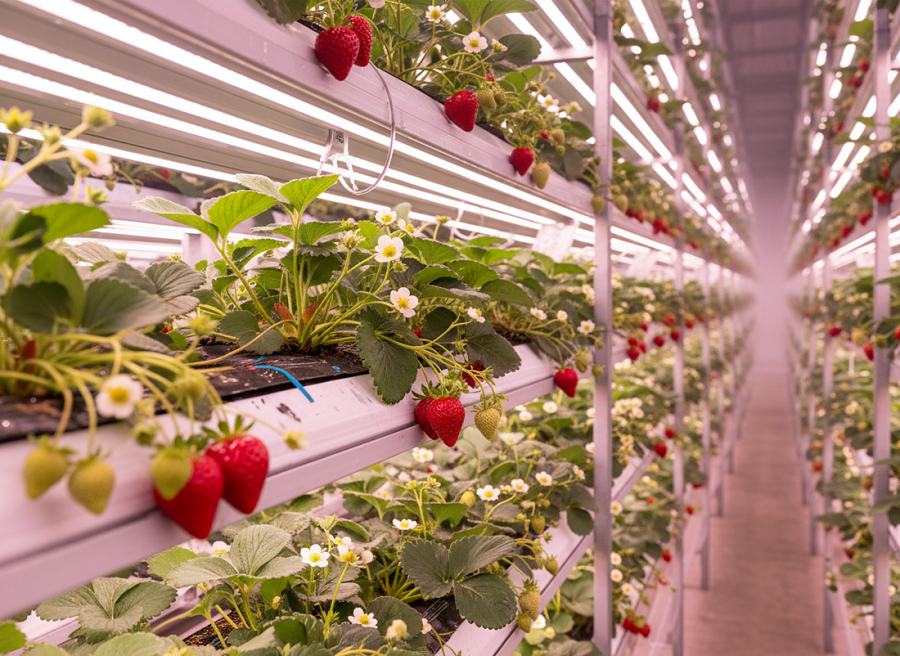
Vertical farming applications rely almost exclusively on LED technology. The compact form factor and low heat generation make multilayer production possible. Strawberries grown in vertical systems require grow lights for strawberries that deliver uniform intensity across all production levels.
Hybrid operations combining natural sunlight with supplemental lighting see strong performance improvements with LED systems. The ability to adjust spectrum and intensity based on available natural light optimizes energy usage. This approach reduces operating costs while maintaining production targets.
What Should Growers Consider When Switching to LED Systems?
Facility assessment comes first. Evaluate current electrical capacity, mounting infrastructure, and environmental control systems. LED installations may require minor adjustments to maximize performance benefits.
Crop management practices may require refinement when transitioning from fluorescent lighting. Light intensity, spectrum settings, and photoperiod strategies differ. Working with experienced lighting partners ensures smooth transitions and optimized results.
Training your team on LED system operation and control capabilities is essential. While LEDs require less maintenance than fluorescent fixtures, understanding digital control systems ensures maximum return on investment.
Making the Right Choice for Your Strawberry Operation
The evidence strongly favors dynamic LED technology for commercial strawberry production. Superior energy efficiency, longer lifespan, and spectrum control deliver measurable operational advantages. Growers who adopt LED systems position themselves for long-term competitiveness.
Traditional fluorescent lighting supported greenhouse production for many years. However, modern LED innovations now provide precision, efficiency, and scalability that fluorescent systems cannot match.
Your lighting choice influences energy costs, crop quality, and production stability. Investing in advanced LED technology supports sustainable growth and consistent yields in today’s competitive horticulture market.
Ready to Transform Your Strawberry Production?
GROW3, a division of LED Smart Inc., delivers advanced LED grow lighting solutions designed specifically for professional greenhouse and vertical farming operations across North America. Our systems feature innovative digital color ratio technology and deliver superior photosynthetic photon flux density (PPFD) for maximum crop performance. Built on decades of engineering expertise, we provide lighting systems engineered for reliability, scalability, and measurable return on investment. Contact us to learn how GROW3 can optimize your strawberry production strategy.