
Industrial surface preparation determines how well coatings adhere, how long assets resist corrosion, and how reliably equipment performs over time. Across fabrication shops, manufacturing plants, energy facilities, and infrastructure projects, the choice of abrasive media plays a decisive role in blasting outcomes. This is why sandblasting services in Calgary and across Alberta focus on matching abrasive media to specific industrial demands rather than relying on a single blasting method.
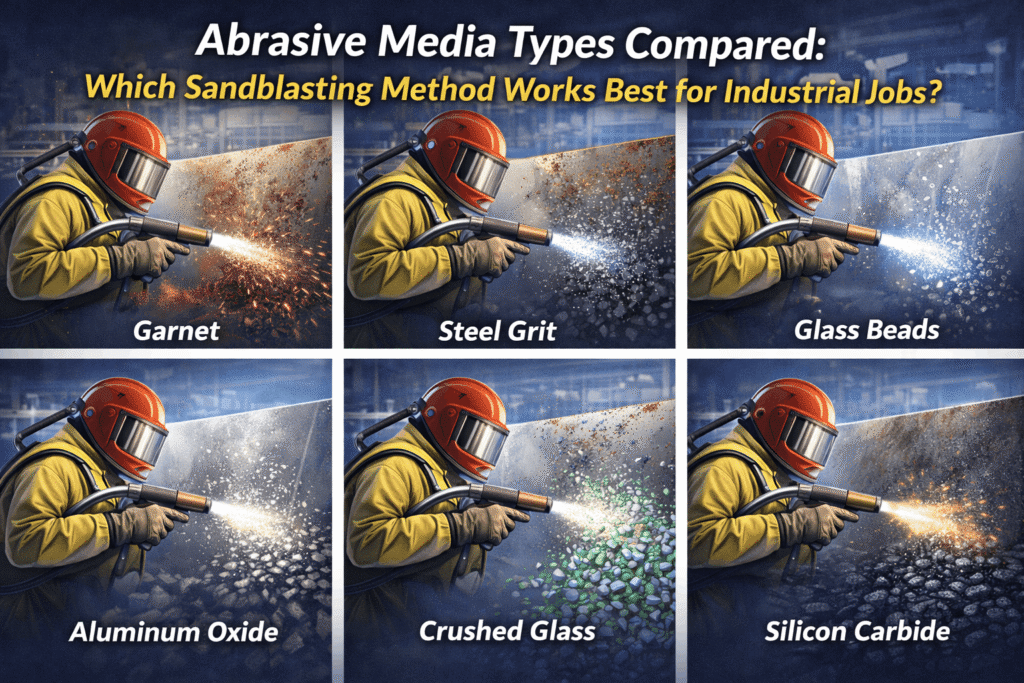
Abrasive media are not interchangeable. Each type differs in cutting aggressiveness, surface profile depth, dust generation, recyclability, and contamination risk. Comparing these media side by side helps industrial operators select the most effective sandblasting method for their application.
Aluminum Oxide vs Steel Grit: Precision Cleaning or Aggressive Material Removal?
Aluminum oxide and steel grit are two of the most commonly specified abrasives, but they serve very different purposes.
Aluminum oxide delivers sharp, fast cutting action with excellent control over surface profile. It is well-suited for:
- Precision surface preparation
- Components requiring consistent roughness before advanced coatings
- Applications where controlled material removal is critical
Steel grit, by contrast, is designed for heavy-duty removal. Its angular steel particles aggressively cut through thick coatings, heavy rust, and scale while producing a deep anchor profile. Facilities using sandblasting services in Edmonton often specify steel grit for:
- Structural steel
- Heavy equipment and machinery
- Components requiring maximum coating adhesion
In short, aluminum oxide prioritizes precision, while steel grit prioritizes speed and depth.
Steel Grit vs Garnet: Productivity Versus Clean Blasting Environments
Steel grit and garnet differ significantly in their impact on productivity, cleanliness, and environmental control.
Steel grit offers:
- Rapid material removal
- Deep surface profiles
- High efficiency in automated or enclosed blasting systems
However, it can generate higher dust levels and requires recovery systems when used in open environments.
Garnet provides a cleaner blasting experience. It produces less dust, improves visibility, and reduces airborne particulate levels. Garnet is often selected for:
- Projects requiring high-quality surface finishes
- Environments with strict environmental or safety controls
- Situations where minimizing cleanup and contamination is important
Steel grit excels in high-throughput industrial applications, while garnet performs better where cleanliness and environmental management are critical.
Garnet vs Aluminum Oxide: Finish Quality and Surface Control
When comparing garnet and aluminum oxide, the primary distinction lies in surface finish control and cutting intensity.
Aluminum oxide is more aggressive and delivers faster coating and corrosion removal. It creates sharp, well-defined surface profiles ideal for high-performance coating systems.
Garnet, while still effective, offers a slightly gentler cutting action. This makes it suitable for:
- Controlled cleaning
- Applications requiring reduced substrate damage
- Projects where finish consistency outweighs removal speed
For tightly specified coatings, aluminum oxide typically offers greater control, while garnet strikes a balance between performance and cleanliness.
Stainless Steel Shot and Grit vs Traditional Steel Abrasives
Stainless steel abrasives differ from carbon steel grit and shot in both composition and application scope.
Traditional steel grit and shot are effective for structural and heavy-duty blasting but introduce ferrous contamination, which may be unacceptable in certain environments.
Stainless steel shot and grit are selected where contamination control is critical. These media:
- Resist corrosion
- Can be recycled multiple times
- Prevent ferrous residue on blasted surfaces
Industries such as food processing, pharmaceutical manufacturing, and specialized fabrication often rely on stainless steel abrasives to maintain material integrity and cleanliness.
Comparing Abrasive Media by Industrial Application
Different industries prioritize different blasting outcomes:
- Manufacturing and fabrication often favor aluminum oxide for precision and repeatability
- Energy, mining, and infrastructure applications commonly rely on steel grit for deep profiles and durability
- Environmentally sensitive or regulated facilities prefer garnet or stainless steel abrasives
- High-volume operations benefit from recyclable steel or stainless steel media
Selecting the wrong abrasive can lead to poor coating adhesion, excessive material loss, or increased operational costs.
Alberta-Specific Considerations When Comparing Sandblasting Media
Industrial assets in Alberta are exposed to extreme temperature swings, moisture, and corrosive operating conditions. Sandblasting services must consider:
- Coating system requirements
- Corrosion exposure levels
- Environmental and safety regulations
Media that produce consistent profiles and support durable coatings are essential for assets operating in oil and gas, power generation, mining, and infrastructure sectors.
Safety and Environmental Trade-Offs Between Abrasive Media
Comparing abrasive media also involves evaluating health and environmental impact. Lower-dust abrasives, reduced silica content, and recyclable media help:
- Improve worker safety
- Reduce environmental exposure
- Maintain regulatory compliance
Modern blasting operations increasingly favor media that balance performance with responsible handling.
Choosing the Best Sandblasting Method for Industrial Results
No single abrasive media works best for every industrial job. Aluminum oxide, steel grit, garnet, and stainless steel abrasives each deliver distinct advantages depending on surface condition, coating requirements, and operating environment.
Comparing abrasive media based on performance, cleanliness, recyclability, and application suitability ensures sandblasting services deliver consistent surface preparation and coatings that perform reliably under Alberta’s demanding industrial conditions.