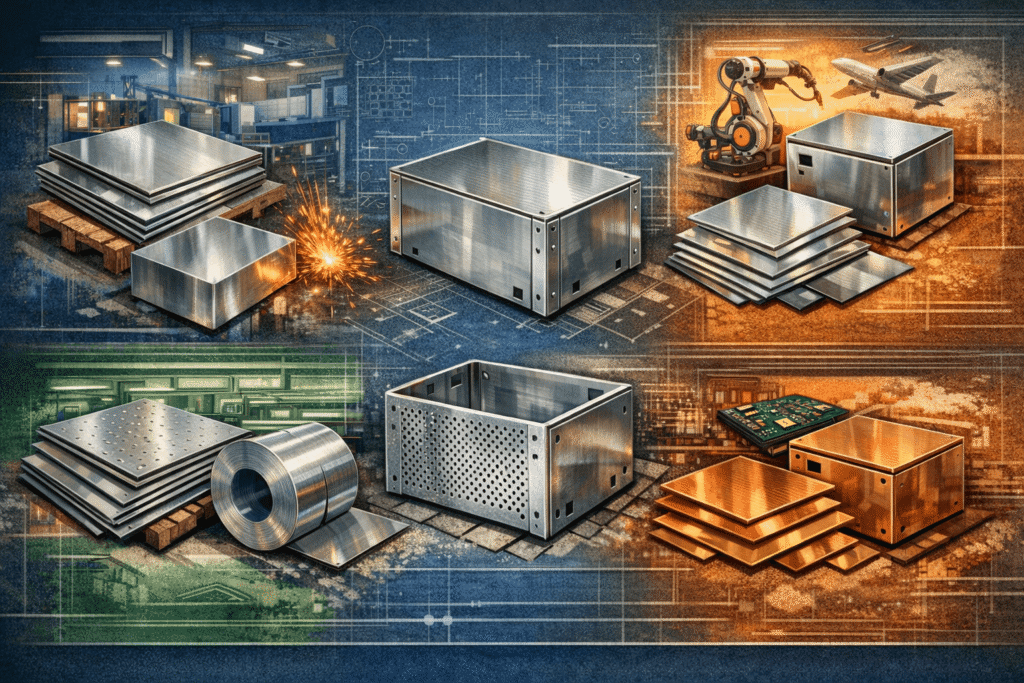

Sheet metal box fabrication supports a wide range of commercial and industrial applications across Canada. From electronics enclosures to medical device housings, material selection directly influences strength, durability, formability, and long-term performance.
In custom sheet metal fabrication, precision does not begin at the press brake or stamping tool. It begins with choosing the right material. Engineered components today demand tighter tolerances, stable geometries, and predictable behaviour under load. Selecting an unsuitable metal can introduce issues before assembly even begins.
The following four material choices consistently yield reliable sheet-metal box fabrication outcomes.
1. Mild Steel: A Reliable Foundation for General Fabrication
Mild steel remains one of the most widely used materials in sheet metal box fabrication. Its balanced mechanical properties make it suitable for a broad range of enclosure and housing applications.
Why mild steel works well:
- Predictable bending and forming behaviour
- Strong weldability
- Excellent machinability
- Cost-effective for medium-to-high volume production
Mild steel is commonly selected when additional surface protection, such as powder coating or plating, is applied. This combination delivers dependable structural performance while supporting efficient fabrication workflows.
2. Stainless Steel: Strength and Corrosion Resistance Combined
Stainless steel is often chosen for sheet-metal boxes exposed to moisture, chemicals, or stringent cleanliness requirements. It supports both structural durability and environmental resistance.
Key performance advantages include:
- High tensile strength
- Resistance to corrosion and oxidation
- Consistent surface finishes for industrial and medical environments
- Stable forming when matched with appropriate tooling
Specific stainless steel grades are frequently used when long-term reliability and resistance to harsh conditions outweigh weight or cost considerations.
3. Aluminum: Lightweight Performance Without Compromise
Aluminum plays a critical role in applications where weight reduction is essential but structural integrity cannot be sacrificed.
Benefits of aluminum sheet metal include:
- High strength-to-weight ratio
- Natural corrosion resistance
- Smooth forming and stamping characteristics
- Strong thermal and electrical conductivity
Sheet metal boxes made from aluminum are common in electronics, transportation equipment, and industrial assemblies where handling efficiency and reduced mass matter.
4. Coated and Treated Steels: Application-Driven Protection
Beyond base materials, coated and treated steels offer targeted performance improvements for specific environments.
Common advantages include:
- Enhanced corrosion resistance
- Improved surface durability
- Extended service life in demanding conditions
- Compatibility with stamping and CNC machining
Galvanized or pre-finished steels are often selected when environmental exposure is known and consistent, allowing fabricators to balance protection with manufacturability.
5 Drivers of Smart Material Selection in Sheet Metal Fabrication
Material choice is rarely based on a single property. Sheet metal fabrication companies evaluate multiple factors to ensure stable performance throughout production and use.
1. Durability Requirements
Applications involving vibration, load, or prolonged exposure often favour stainless steel or treated steels over lightweight options.
2. Formability and Bend Control
Sheet metal boxes rely on clean bends, flanges, and joints. Predictable bend radius behaviour, springback control, and tool compatibility improve repeatability.
3. Environmental Exposure
Moisture, chemicals, and cleaning cycles influence whether stainless steel, coated mild steel, or aluminum is most appropriate.
4. Weight Constraints
Aluminum supports weight reduction without compromising structural stability, especially in portable or transport-sensitive assemblies.
5. Compatibility With Secondary Processes
Material must perform consistently through:
- Stamping sequences
- Deburring
- Surface finishing
- Fastener welding
- Electromechanical assembly integration
Consistent material behaviour across these steps supports production efficiency and dimensional accuracy.
Why Material Expertise Matters
Material selection defines the quality, consistency, and reliability of the final fabricated box. Experience in custom sheet metal fabrication shows that matching the right material to the right process reduces rework, minimizes delays, and improves long-term performance.
Across aerospace, medical, electronics, and industrial applications, smart material decisions are grounded in precision, repeatability, and manufacturability.