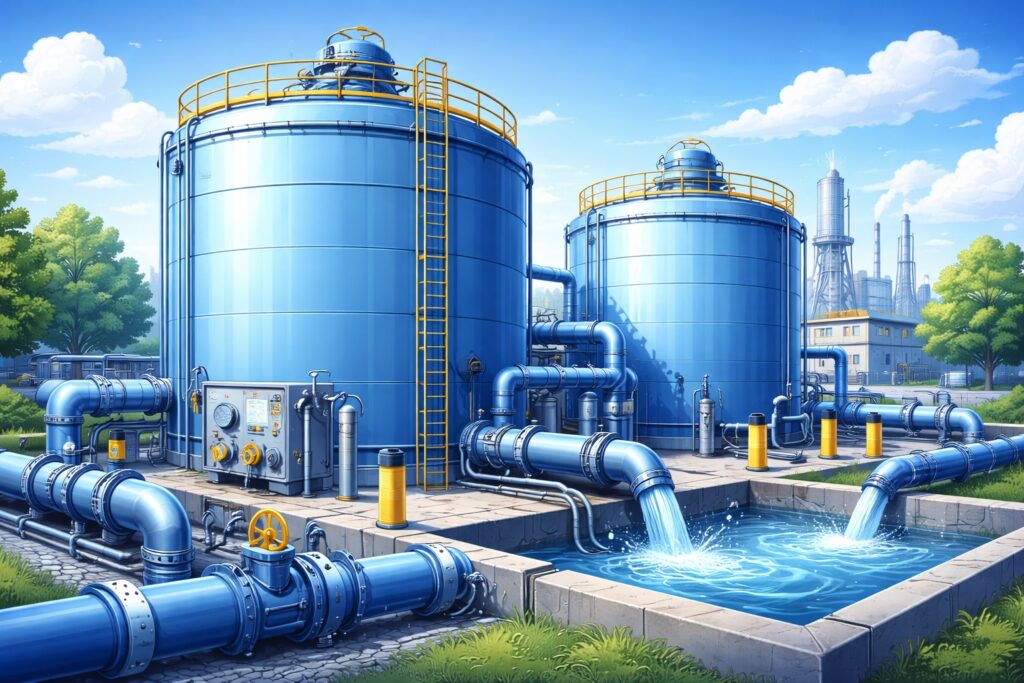

Water is the foundation of countless industrial operations—from cooling systems and steam generation to sanitation, processing, and chemical dilution. As production capacity expands and operations diversify, water usage patterns shift significantly. That’s why facilities must invest in industrial water tank systems that not only meet present-day demands but also scale efficiently with future growth.
Engineered water tank systems are built to evolve alongside facility infrastructure, minimizing retrofit costs and supporting operational continuity over time.
Forecasting Long-Term Water Needs for Industrial Processes
One of the most common pitfalls in industrial storage planning is underestimating future water consumption. Whether the facility handles pharmaceuticals, textiles, chemicals, or food processing, water requirements tend to increase as production lines expand, new processes are added, or regulatory changes mandate additional sanitation.
Accurate forecasting should consider:
- Peak usage periods vs. baseline daily demand
- Projected production capacity over 5 to 15 years
- Shift schedules and water-intensive processes
- Contingency storage for fire suppression or system failure
- Regulatory changes that may impact water treatment or recycling
Facilities with strategic planning in place can avoid costly overhauls, emergency water sourcing, or production delays. A well-planned commercial water storage tank system supports both operational scale and fluid flexibility.
Sizing and Configuring Tanks for Fluctuating Usage
Water usage in industrial environments is rarely static. Many facilities experience cyclical or seasonal spikes, driven by:
- Batch production schedules
- Maintenance routines
- Supply chain variability
- Regulatory flushing requirements
Storage systems must be sized not just for daily averages but for high-demand intervals and potential emergencies. To do this effectively, engineers work with:
- Peak demand buffers (e.g., 20-30% above average demand)
- Dedicated reserve volumes for critical services
- Integrated flow control systems to regulate tank inflow and discharge
Tank configuration also plays a role. A series of smaller tanks offers better control over volume management, cleaning schedules, and redundancy than a single oversized tank. Tanks can be staggered in fill/discharge cycles to manage water turnover and reduce the risk of stagnation.
Modular Tank Designs for Phased Expansions
One of the most cost-effective strategies for scaling water storage is modular design. Rather than building oversized infrastructure upfront, facilities can implement a modular system with:
- Interconnected tanks of uniform design
- Shared control and monitoring systems
- Pre-planned expansion zones and pad foundations
- Detachable piping or valving for fast reconfiguration
These modular systems allow facilities to add capacity without shutting down operations or redesigning entire systems. For new construction or retrofits, modular planning minimizes disruption and reduces capital risk.
Manufacturers offers scalable, modular tank systems for industrial environments, allowing facilities to implement phased upgrades aligned with actual growth—not just forecasts.
Tank Material Selection Based on Location and Contents
Choosing the right material for an industrial water tank depends heavily on geography, stored water type, and the tank’s physical location (indoor vs. outdoor).
Common materials include:
- Fiberglass Reinforced Plastic (FRP): Ideal for corrosive environments or outdoor settings with UV exposure. Offers high chemical resistance and customizable resins for specific water conditions.
- HDPE and Polyethylene: Used for low-pressure systems or non-potable water, but may degrade in sun or freeze-thaw climates.
- Stainless Steel: High durability for sanitary or food-grade applications, but typically more expensive and heavier.
- Concrete: Used for huge tanks, but difficult to retrofit or relocate.
FRP remains the top choice for many facilities because it offers the best balance of durability, chemical resistance, and installation flexibility. It’s also more lightweight than steel, making it easier to transport and mount, especially on raised platforms or rooftops.
Climate is also a critical consideration. Tanks exposed to freezing temperatures may require insulation, heat trace systems, or specific resin formulations to maintain structural integrity. In warm climates, UV-stable coatings and venting systems are essential to prevent algae growth and thermal expansion.
Working with Manufacturers on Site-Specific Configurations
No two industrial sites are alike. The best water tank systems are engineered to address not only usage volume but also site-specific constraints. During the design and procurement process, water tank manufacturers should evaluate:
- Footprint availability and structural load limits
- Ease of delivery and rigging for installation
- Access to drainage, overflow, and inspection ports
- Height and spacing restrictions in existing infrastructure
- Seismic, wind, or snow load requirements
Collaboration among facilities managers, engineers, and tank manufacturers results in a system that integrates smoothly with pumps, control systems, filtration, and chemical treatment. It also ensures that installation and maintenance can be completed without delays or costly rework.
A well-designed tank isn’t just a product—it’s a system component that interacts with flow control, data collection, safety, and maintenance workflows.
Budgeting for Installation, Retrofits, and Compliance Inspections
While tank price is often the first consideration, total lifecycle cost should guide final decisions. Budgeting must account for:
- Site preparation (pads, grading, secondary containment)
- Crane or rigging services for installation
- Permitting and inspection fees
- Integration with SCADA or automation systems
- Ongoing cleaning, inspection, and recertification
- Future expansion or decommissioning plans
In regulated industries, inspections may be required annually or every few years. These inspections often involve:
- Ultrasonic wall thickness testing
- Drain and vent function checks
- Overflow valve calibration
- Internal inspection with confined-space entry
Specifying tanks that support easy access, fast drainage, and integrated monitoring speeds compliance, makes it safer, and reduces disruption. When selected and maintained properly, industrial storage tanks can perform reliably for 20–30 years.