
Construction and infrastructure projects require structured acoustic and vibration control from the planning stage. Heavy equipment, piling, excavation, demolition, roadwork, transit work, and active site operations can generate measurable impacts on nearby buildings, utilities, sensitive facilities, and surrounding communities.
Noise and vibration consultants help project teams assess, monitor, document, and manage these impacts through engineering-based evaluation. Vibration consultants also support projects where ground-borne vibration from construction activity may affect adjacent structures, occupants, sensitive equipment, or regulatory compliance.
What Is the Role of Noise and Vibration Consultants?
Noise and vibration consultants evaluate how construction or infrastructure activity may affect surrounding buildings, communities, and sensitive receptors. Their work helps developers, contractors, engineers, public-sector agencies, and infrastructure owners make informed decisions throughout the project lifecycle.
Their services may include:
- Baseline acoustic and vibration measurement
- Construction-phase monitoring
- Predictive modelling and technical analysis
- Regulatory and project-specific compliance reporting
- Mitigation recommendations
- Documentation for project owners, authorities, or legal teams
This work creates a defensible technical record before noise or vibration concerns become approval, schedule, or stakeholder issues.
Why Noise and Vibration Assessment Matters Before Construction Begins
Pre-construction assessment is one of the most important steps in managing acoustic and vibration risk. Baseline data establishes existing site conditions before work starts. Without this record, it becomes harder to distinguish pre-existing conditions from construction-related impacts.
Early assessment also helps identify sensitive nearby receptors, such as:
- Hospitals and healthcare facilities
- Schools and institutional buildings
- Offices and occupied commercial properties
- Multi-unit residential developments
- Transit corridors and utility infrastructure
- Heritage structures and vibration-sensitive buildings
This early evaluation supports better decisions before site access, equipment selection, work sequencing, and construction methodology become fixed.
How Consultants Support Project Planning
Consultants review project scope, construction methods, site conditions, surrounding land uses, equipment activity, and regulatory expectations to determine where acoustic and vibration risks may arise.
Planning support may include:
- Construction staging
- Equipment selection
- Work-hour restrictions
- Monitoring locations
- Baseline measurement points
- Stakeholder communication
- Compliance documentation
- Reporting frequency and alert procedures
Predictive analysis can also help project teams understand how proposed work may affect nearby receptors before construction starts.
What Happens During Noise Measurement Services?
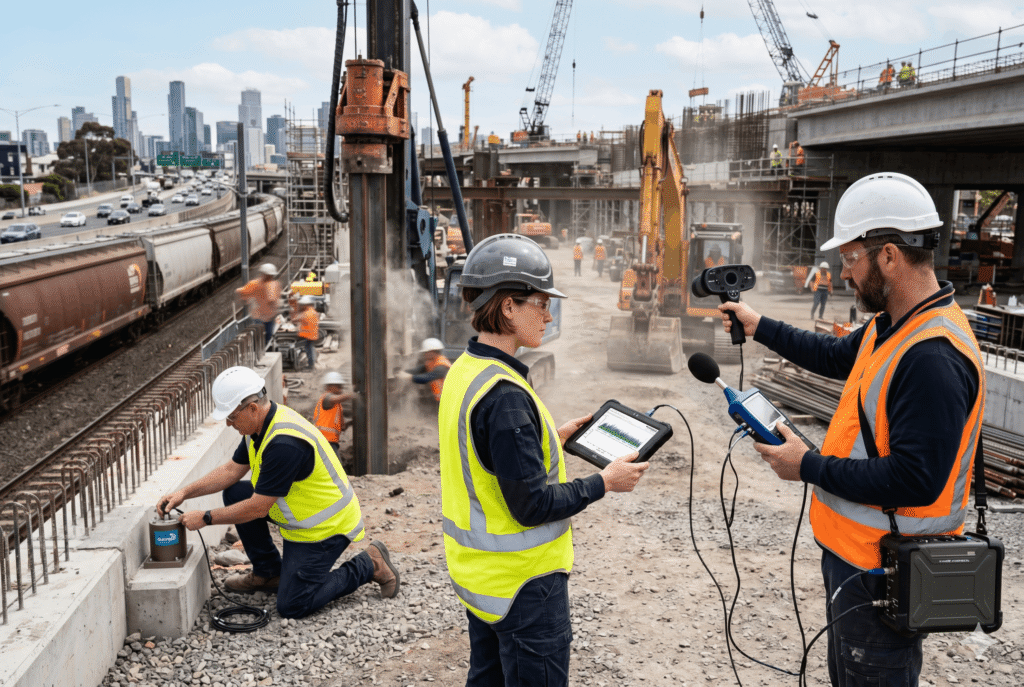
Noise measurement services involve the systematic measurement and analysis of sound levels within and around a construction site. Consultants use calibrated equipment to collect sound level data at relevant locations, such as property lines, nearby sensitive receptors, mechanical areas, or public-facing project boundaries.
Depending on the project, measurement programs may include short-term attended measurements, long-term unattended monitoring, baseline readings, or construction-phase measurements. The collected data supports technical reports, regulatory review, mitigation decisions, and communication with project stakeholders.
Why Noise Measurement Supports Compliance and Project Control
A structured noise monitoring program helps project teams maintain compliance, reduce risk, and respond to issues with defensible data. It also helps connect field conditions with municipal bylaws, permit requirements, environmental commitments, and project-specific criteria.
Noise measurement can support:
- Avoiding fines by tracking whether sound levels remain within applicable limits
- Preventing delays by identifying issues before they trigger complaints or investigations
- Legal protection through detailed records that demonstrate due diligence
- Permit or exemption support when extended work hours require technical justification
- Better community communication through transparent, data-supported reporting
- Source identification when teams need to distinguish site-generated noise from unrelated background activity
- Optimized mitigation so barriers, sequencing, or operational controls are proportionate rather than excessive
This makes noise measurement more than a reporting exercise. It becomes a project control tool that supports compliance, schedule protection, and practical decision-making.
What Do Vibration Consultants Measure on Construction Sites?
Vibration consultants measure ground-borne vibration caused by equipment and construction activity. These measurements help assess whether vibration levels may affect nearby structures, occupants, sensitive equipment, or facilities.
Construction activities that may require vibration monitoring include:
- Pile driving
- Excavation
- Demolition
- Compaction
- Transit construction
- Road construction
- Blasting-related activity, where applicable
Vibration data supports decisions about construction methods, equipment operation, monitoring thresholds, and mitigation strategies.
Noise and Vibration Monitoring During Active Construction
Active construction monitoring helps project teams track site impacts as work progresses. Monitoring may occur in real time or at scheduled intervals, depending on the project’s risk profile, regulatory conditions, and surrounding land uses.
A monitoring program may include alerts, trend data, field observations, and regular reporting. When measured levels approach project criteria or regulatory limits, the project team can take corrective action before impacts escalate.
This makes monitoring a practical risk management tool for contractors, developers, and infrastructure owners.
Compliance Support for Construction and Infrastructure Projects
Construction and infrastructure projects are often subject to municipal, provincial, environmental, and project-specific noise and vibration requirements. Consultants help project teams understand which criteria apply and how those criteria should be addressed in planning, monitoring, and reporting.
Compliance support may involve:
- Environmental assessment documentation
- Permit condition support
- Construction management plans
- Noise and vibration control plans
- Stakeholder response documentation
- Technical reports for authorities or project owners
- Documentation for legal or dispute-related review when required
Clear documentation helps demonstrate that project teams are managing acoustic and vibration impacts responsibly.
Mitigation Recommendations Based on Engineering Data
Noise and vibration consultants do more than collect data. They interpret results and recommend practical controls based on site conditions, construction methods, and applicable criteria.
Mitigation planning may include adjusting construction sequencing, selecting lower-impact methods where feasible, establishing buffer zones, managing equipment schedules, improving site layout, installing temporary acoustic barriers where appropriate, and strengthening monitoring procedures.
The goal is not to overdesign controls. The goal is to apply proportionate, technically defensible mitigation that supports compliance, constructability, and project continuity.
Why Infrastructure Projects Need Specialized Consultants
Infrastructure projects often carry higher acoustic and vibration complexity than standard construction projects. Transit lines, roads, bridges, utilities, and public works projects may extend across long timelines, multiple jurisdictions, and varied surrounding land uses.
These projects may involve multiple contractors, high public exposure, sensitive adjacent buildings, strict documentation expectations, and both construction-phase and operational-phase acoustic considerations. Specialized consultants help connect measurement, modelling, monitoring, mitigation, and reporting across the full project lifecycle.
Why Work With a Qualified Consulting Engineer?
Technical acoustic and vibration issues require qualified engineering judgment. Measurements alone are not enough if the data is not interpreted correctly or connected to project-specific requirements.
A qualified consulting engineer can provide defensible reports, calibrated measurements, practical mitigation recommendations, regulatory interpretation, construction-phase monitoring strategies, and technical support for complex approvals or disputes.
Valcoustics Canada Ltd. is positioned as a qualified acoustic consulting engineer for construction and infrastructure projects. Their work supports project teams through acoustic monitoring, noise and vibration analysis, compliance support, and project-specific engineering recommendations.
Conclusion
Vibration consultants and noise and vibration consultants support construction and infrastructure projects through assessment, measurement, monitoring, mitigation planning, and compliance documentation. Their work helps project teams understand site impacts, protect nearby receptors, respond to regulatory expectations, and make stronger technical decisions.
Early involvement allows acoustic and vibration considerations to be integrated into planning, design, procurement, and construction sequencing before risks become harder to manage. Partner with Valcoustics Canada Ltd. to plan, monitor, and manage construction noise and vibration impacts with qualified engineering support.