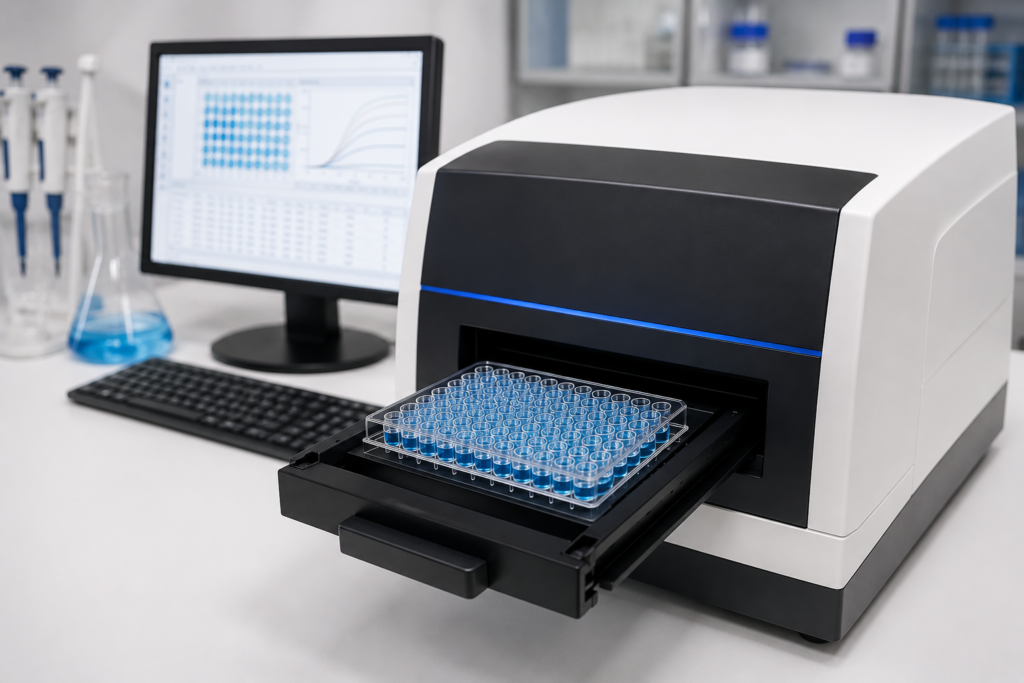

Laboratories investing in advanced detection systems often focus heavily on assay requirements and throughput goals. However, selecting the wrong platform can create workflow inefficiencies, integration problems, and long-term operational limitations that impact both productivity and data quality.
A multimode microplate reader supports a wide range of applications, including fluorescence, absorbance, luminescence, and kinetic assays. Yet many laboratories overlook critical technical and workflow considerations during procurement.
Understanding the most common purchasing mistakes can help laboratories make more informed decisions while supporting long-term scalability and workflow reliability.
1. Overlooking Optical Hardware Differences in a Multimode Microplate Reader
One of the most common procurement mistakes is failing to evaluate the optical system architecture carefully.
Modern systems generally use:
- Filter-based optics
- Monochromator-based optics
- Hybrid optical configurations
Filter-based systems often provide faster read times and strong sensitivity for predefined assays. Monochromator systems offer greater wavelength flexibility and support a broader range of assay development applications.
Many laboratories are now shifting toward hybrid optical systems that combine sensitivity with wavelength tuning flexibility.
Selecting the wrong optical configuration may reduce workflow efficiency or limit future assay expansion. Laboratories should evaluate current assay requirements while considering future workflow scalability before choosing a platform.
2. Neglecting Software Interoperability for Automated Microplate Readers
Laboratory automation increasingly depends on seamless communication between instruments, workflow software, and laboratory information management systems.
Unfortunately, many laboratories prioritize hardware specifications while overlooking software interoperability.
Modern automated microplate readers should support:
- Streamlined data export
- Workflow scheduling
- Assay protocol management
- LIMS compatibility
- Audit trail functionality
Laboratories operating in regulated environments also require strong data integrity and compliance support.
Poor software integration often introduces manual data-handling steps that slow workflows and increase processing complexity. In many cases, laboratories experience significant delays when systems cannot communicate efficiently with existing infrastructure.
Before purchasing a system, laboratories should verify compatibility with current software environments and future automation plans.
3. Underestimating High-Density Plate Support in a Multimode Microplate Reader
Many laboratories purchase systems based only on immediate throughput needs without considering future assay expansion.
As laboratories transition toward higher-density microtiter plate formats, compatibility becomes increasingly important for maintaining workflow scalability.
Modern systems may support:
- Standard assay plates
- High-density plate configurations
- Robotic plate handling
- Continuous plate feeding systems
Laboratories implementing automation workflows should also evaluate their robotic integration capabilities to ensure smooth coordination between liquid-handling systems and detection platforms.
Ignoring scalability requirements can limit sample throughput and create bottlenecks as testing demands increase. Laboratories using integrated automation environments often achieve substantially higher daily processing capacity when systems are designed for high-density workflows.
4. Forgetting Environmental Controls for Kinetic Assay Applications
Environmental control capabilities are often overlooked during procurement, especially in laboratories focused primarily on standard endpoint assays.
However, kinetic assays and cell-based applications frequently require:
- Stable temperature regulation
- Atmospheric consistency
- Controlled gas environments
- Uniform plate heating
Precise environmental controls improve assay reproducibility and support more reliable data generation across replicate wells.
Laboratories performing long-duration kinetic workflows increasingly prioritize systems with advanced atmospheric regulation features because inconsistent environmental conditions can introduce variability into assay results.
Evaluating these features early helps laboratories avoid workflow limitations that may impact future assay development projects.
5. Dismissing Certified Refurbished Microplate Readers as Unreliable
Many laboratories still assume that refurbished systems carry a higher operational risk than new equipment. However, this perception often overlooks the growing adoption of certified refurbished laboratory instruments across research and diagnostic environments.
Properly certified systems undergo:
- Optical validation
- Calibration testing
- Component inspection
- Software verification
- Workflow performance testing
These processes help ensure systems meet operational standards before deployment.
Copia Scientific supports certified pre-owned laboratory equipment through the Copia Certification Process (CCP). This includes inspection, testing, calibration, and workflow validation procedures.
For many laboratories, certified systems provide reliability comparable to that of new instruments while reducing capital investment pressure and improving procurement flexibility.
Making a More Informed Microplate Reader Investment
Selecting the right microplate detection platform requires more than comparing basic specifications. Laboratories should evaluate optical architecture, software interoperability, automation compatibility, environmental controls, and long-term workflow scalability together.
Carefully assessing these factors helps reduce operational risk while improving workflow efficiency and assay reproducibility.
Laboratories exploring certified systems should also prioritize vendors that provide documented testing, calibration, validation, warranty coverage, and technical support throughout the equipment lifecycle.
As automation demands continue to grow, properly validated and integrated microplate readers can provide laboratories with a practical and scalable approach to supporting long-term operational performance.
Contact Copia Scientific for certified multimode microplate reader solutions designed to support scalable, high-throughput laboratory workflows.