
Canadian manufacturing relies on precision, repeatability, and material consistency.
Fabrication processes play a central role in meeting these requirements across regulated and high-volume industries. From aerospace components to industrial enclosures, material selection directly affects part performance, manufacturability, and long-term reliability.
However, not every metal is suitable for repeatable, production-focused custom metal fabrication. Certain materials continue to form the backbone of Canadian manufacturing because they balance strength, machinability, and availability.
This article outlines the key metals that support industrial fabrication processes in Canada and explains why they remain widely used across industrial applications.
Why Material Selection Matters in Custom Metal Fabrication
Material choice affects every stage of fabrication. It influences tooling life, machining consistency, forming accuracy, and inspection outcomes. In regulated industries, it also supports compliance with documented quality systems and repeatable production standards.
Well-selected metals help manufacturers achieve:
- Predictable machining and stamping results
- Consistent tolerances across production runs
- Stable supply chains within Canada and North America
- Compatibility with secondary operations, such as forming and assembly
For these reasons, Canadian manufacturers continue to rely on proven metals rather than experimental or difficult-to-machine alternatives.
Carbon Steel: A Foundation Material in Canadian Fabrication
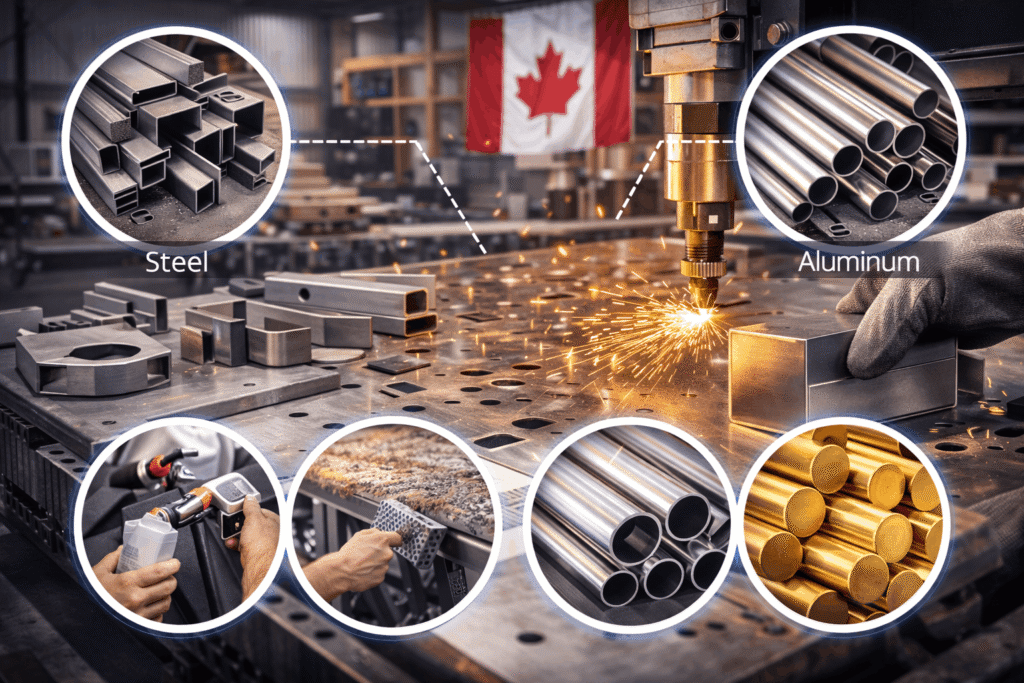
Carbon steel remains one of the most widely used materials in custom metal fabrication.
Its strength, affordability, and predictable behaviour make it suitable for stamped and machined components in industrial equipment and structural applications.
Common advantages include:
- Reliable formability for stamping operations
- Consistent machinability on 3-axis CNC equipment
- Broad availability in Canadian supply chains
Carbon steel is often a common choice for brackets, frames, and enclosures where durability and dimensional stability are essential.
Stainless Steel: Strength with Corrosion Resistance
Stainless steel is a frequent choice for applications where corrosion resistance and cleanliness are essential. Canadian manufacturers in medical, aerospace, and industrial environments depend on stainless grades that perform well under repeated use and controlled conditions.
Key characteristics include:
- Resistance to corrosion and oxidation
- Structural integrity in thin-gauge applications
- Suitability for precision machining and sheet metal forming
Stainless steel components support long service life while maintaining tight dimensional requirements.
Copper: Conductivity for Specialized Components
Custom tool manufacturers choose copper for applications that require electrical conductivity and thermal transfer. In Canadian manufacturing, copper components are common in electrical and electromechanical systems that demand precision and consistency.
Key advantages include:
- High electrical conductivity
- Predictable performance during machining operations
- Suitability for low-volume, precision components
Copper supports fabrication where performance depends on reliable current flow and repeatable tolerances.
Brass: Machinability and Dimensional Stability
Brass offers a balance between machinability and strength. It is often used for fittings, connectors, and precision parts that require clean finishes and stable dimensions.
Why brass remains relevant:
- Smooth machining characteristics
- Reduced tool wear
- Consistent results across production batches
Brass components are common in industrial and commercial assemblies where reliability and accuracy are essential.
Material Consistency and Quality Standards in Canadian Manufacturing
Canadian manufacturers operate under strict quality expectations. Material traceability, documentation, and repeatability support long-term production planning and regulatory compliance.
Custom metal fabrication services benefit from metals that:
- Maintain consistent properties across suppliers
- Perform reliably in documented processes
- Support ISO-aligned quality systems
This alignment allows manufacturers to scale production while maintaining control over quality outcomes.
Supporting Canadian Manufacturing with Proven Materials
Custom tool fabrication continues to rely on metals that deliver predictable performance.
Carbon steel, stainless steel, copper, and brass remain essential because they support precision machining, stamping, and repeatable production workflows.
For organizations evaluating material options for stamped or CNC-machined components, working with a structured fabrication provider helps align material selection with production goals. Contact a reliable fabricator to learn more about material choice in custom metal fabrication in Toronto.