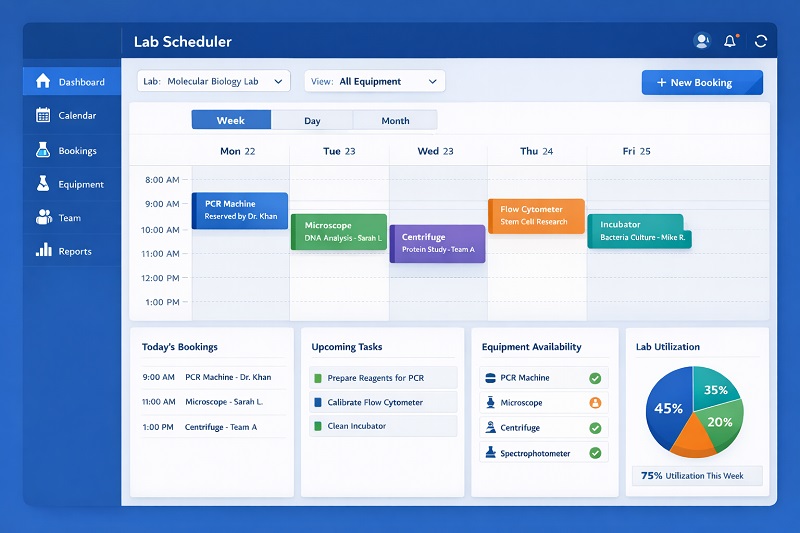

Biotech automation is no longer just about adding robots or instruments—it’s about coordinating everything they do. As labs scale throughput and run multiple workflows in parallel, poor scheduling quickly becomes a bottleneck. Missed handoffs, idle devices, and manual workarounds can erase the gains automation was meant to deliver.
That’s why choosing the right lab scheduling software is a critical decision for biotech teams. Scheduling platforms act as the control layer that determines how efficiently instruments, people, and time are used. Two platforms frequently compared in this space are GENERA and Cellario, each offering a different approach to automation orchestration.
Feature Comparison – Scheduling, Integration, Automation Control
At a high level, both platforms aim to coordinate complex laboratory workflows—but they differ in how they achieve that goal.
Scheduling Intelligence
GENERA is designed as an advanced automated scheduling software. It dynamically adjusts schedules based on task completion, device availability, and workflow dependencies. If a step finishes early or a device becomes available, GENERA automatically reallocates tasks to reduce downtime.
Cellario typically relies on more predefined scheduling logic. This approach works well in environments with fixed, repeatable workflows, but can be less flexible when processes change frequently.
Integration
GENERA integrates directly with a wide range of instruments and systems through APIs and device drivers. This allows labs to automate mixed-vendor environments without rebuilding infrastructure. Integration with LIMS and data systems is also supported, enabling coordinated execution and traceability.
Cellario is often deployed within tightly integrated automation cells. While powerful, integration outside those environments may require additional configuration or constraints.
Automation Control
As automation software, GENERA focuses on orchestration—coordinating multiple devices as a single workflow rather than controlling each instrument in isolation. Cellario provides strong control within fixed robotic systems, particularly in large screening environments where workflows remain stable.
Biotech Use Cases – Sample Prep, Device Orchestration, Throughput
In real-world biotech labs, scheduling software must support diverse and evolving workflows.
For sample preparation, GENERA coordinates liquid handlers, incubators, and readers so each step runs in the correct sequence without manual intervention. Dynamic scheduling ensures samples move smoothly even when timing shifts.
In device orchestration, GENERA manages multiple instruments concurrently, preventing conflicts and maintaining high utilization. This is especially valuable in shared labs where instruments serve various teams.
To optimize throughput, GENERA minimizes idle time by continuously adjusting schedules. Cellario excels in high-throughput environments with fixed automation cells, where predictable workflows benefit from rigid optimization.
Pros & Cons – Strengths and Gaps of Genera, Cellario, GBG
GENERA – Pros
- Flexible integration with mixed-vendor instruments
- Dynamic, adaptive scheduling
- Strong orchestration across workflows
- Scales incrementally as automation expands
GENERA – Considerations
- Best value realized when used as a central orchestration layer
- Requires upfront workflow design for optimal results
Cellario – Pros
- Strong control in fixed automation cells
- Well-suited for large, standardized screening environments
- Proven in high-throughput systems
Cellario – Considerations
- Less flexible for rapidly changing workflows
- Integration outside predefined systems may be limited
GBG – Pros
- Familiar interface for some labs
- Works well for simpler scheduling needs
GBG – Considerations
- Limited orchestration depth
- Less suitable for complex, multi-device automation
Final Verdict – Which Platform Fits Biotech Labs Best and Why
There is no single “best” platform for every lab—only the right fit for your automation strategy. For biotech teams operating fixed, large-scale automation cells with predictable workflows, Cellario remains a strong option.
GENERA is built specifically for biotech labs that need flexibility, scalability, and intelligent orchestration. Our platform adapts as workflows evolve, instruments change, and automation grows incrementally. For many modern R&D environments, that adaptability is critical.
Ultimately, the decision between GENERA and Cellario comes down to how much flexibility your lab requires today—and how much change you expect tomorrow. When evaluating lab scheduling software, biotech teams should prioritize depth of orchestration, integration capabilities, and long-term scalability over short-term convenience.