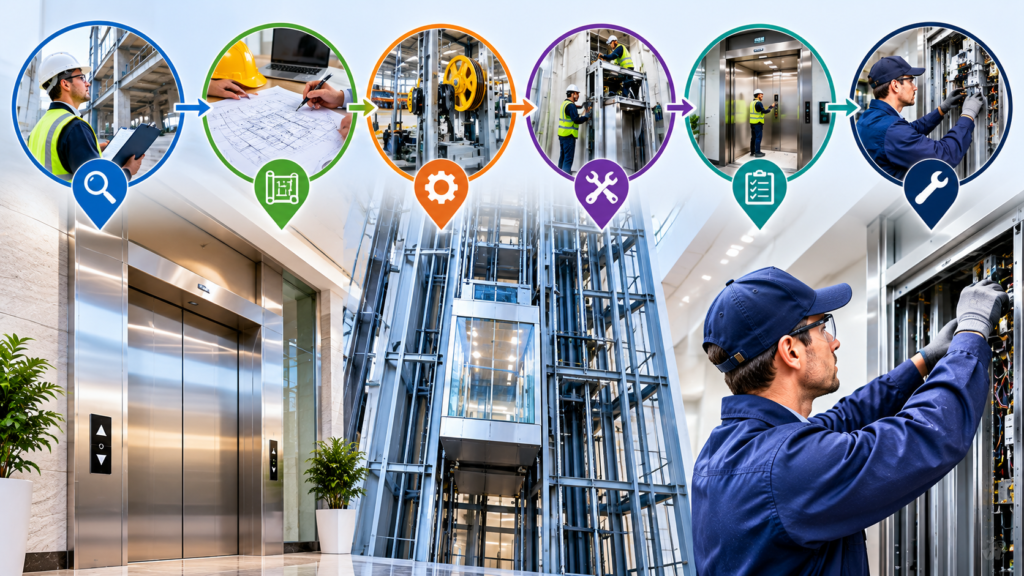

Industrial elevators are long-term assets. A permanent industrial elevator on a silo, stack, or process structure may serve a facility for many years, and decisions made in the first weeks of the project affect its reliability for its entire service life. Treating the project as a lifecycle, rather than a single purchase, helps owners avoid gaps between engineering, installation, operation, and maintenance.
This blog walks through each stage, from defining requirements to replacing aging equipment. These stages apply to every system type described in Industrial Elevator Lift Systems: Types, Applications, and Planning Considerations, whether it serves a silo, a stack, a crane, or a process structure, although details at each stage vary by site.
People Also Ask
What are the stages of an industrial elevator project?
Typical stages include defining requirements, engineering and permitting, equipment selection, delivery and installation, testing and inspection, and operator training and planned maintenance through the equipment’s service life.
Who handles permits for an industrial elevator installation?
Responsibility varies by project. UCEL Inc. handles submissions and permitting in-house, while requirements and review times depend on the jurisdiction and authority having jurisdiction.
How often does an industrial elevator need maintenance?
Intervals depend on the equipment, duty cycle, environment, and jurisdictional requirements. A planned maintenance program sets intervals for each installation.
Defining Operating Requirements and Site Constraints
Every project starts with the site facts: the host structure, travel height, landings, loads, whether personnel will ride, duty cycle, power supply, hazardous area classification, climate, and installation access. Gaps at this stage lead to revisions later, so collecting complete information is worth the effort. This stage should also define who the elevator will serve and what it must achieve. A permanent installation for daily operations access has different priorities than one used mainly during annual shutdowns, and those priorities shape every decision that follows.
Structural details, loads, duty cycle, power supply, and hazardous area classification are the inputs that matter most here, and each is covered in Site and Operating Details to Prepare Before Requesting an Industrial Elevator Quote.
Engineering, Layout Drawings, and Permitting
Once requirements are clear, engineering turns them into a design. This includes layout drawings showing mast position, landings, and clearances, along with tie and anchorage details based on a review of the host structure.
UCEL Inc. provides in-house engineer-stamped drawings and handles submissions and permitting in-house. Keeping engineering and approvals connected to the equipment supplier reduces handoffs between parties and helps keep documentation consistent. Permit requirements and review times vary by jurisdiction, so build them into the schedule early.
Equipment Selection and Customization
With the design defined, finalize the equipment: capacity, speed, car size, drive system, controls, power options, and environmental features such as hazardous location components or cold-weather specifications. When standard models don’t fit the structure or loads, custom configurations may be required.
Selection should also look ahead. Spare parts, maintenance access, and future changes in use all affect how well the equipment serves the facility over time. For a permanent installation, owners should also confirm how parts, service visits, and inspections will be handled before committing to a configuration.
Delivery, Erection, and Tying Into the Structure
Delivery requires access to the base of the structure, laydown space, and, depending on the configuration, crane support. During industrial elevator installation, the base is set, mast sections are erected, and ties are installed according to the engineered design. Landings, gates, and enclosures follow, along with electrical connections.
At operating plants, installation often has to fit within a shutdown window or work around live operations. Coordination with the facility’s safety, operations, and maintenance teams keeps the work on schedule. Tie locations and anchorage details come from the engineering review of the host structure, as described in How Industrial Elevator Masts Are Anchored to Silos, Stacks, and Plant Structures.
Testing, Inspection, and Handover
Before the elevator enters service, test it to confirm that controls, safety devices, landings, and gates function as designed. Acceptance inspections and approvals vary by jurisdiction and by the authority having jurisdiction, so confirm the inspection plan during permitting rather than at the end of the project.
Handover should include operating instructions, maintenance documentation, inspection records, and drawings, giving the facility the information it needs to run and maintain the equipment.
Operator Training and Daily Checks
Trained operators are essential to safe, reliable operation. Training typically covers controls, load limits, landing procedures, emergency procedures, and the facility’s own access rules. UCEL Inc. also runs hoist training at its facility, where manufacturer engineers train UCEL Inc. mechanics and clients’ teams.
Daily or pre-use checks, as set out by the manufacturer and site procedures, help identify issues early. Operators should report unusual noise, vibration, control behavior, or damage to gates and enclosures so that maintenance can respond before minor issues become outages.
Refresh training when new staff joins, when procedures change, and after any significant equipment modification. Contractors brought in for turnarounds also need an introduction to the elevator before they use it.
Planned Maintenance and Life Cycle Scheduling
An industrial elevator maintenance plan covers routine inspections, lubrication, adjustments, wear-part replacement, safety device testing, and recordkeeping. For permanent elevators, UCEL Inc. offers custom maintenance contracts with locked-in pricing, helping facilities budget for maintenance over multiple years.
Maintenance records serve several purposes: they support periodic inspections, reveal recurring issues, and give owners the history they need when evaluating upgrades or replacement.
Life cycle planned maintenance scheduling goes further by anticipating major component replacements over the equipment’s service life. Inspection and maintenance intervals depend on the equipment, its duty cycle, its environment, and jurisdictional requirements, so set them for each installation rather than assuming them.
Upgrading or Replacing an Aging Industrial Lift
Over time, owners may face more frequent repairs, difficulty sourcing parts, changing operating needs, or updated code requirements. At that point, the choice is between continued repair, modernization of components such as controls or drives, or full replacement.
The decision should consider the condition of the mast and ties, the structure, maintenance history, downtime costs, and changes in the facility’s access needs. A replacement project returns to the start of the lifecycle, beginning with a fresh assessment of operating requirements and site constraints.
Conclusion
Planning the full lifecycle from the start helps facility owners avoid gaps between parties and protects their investment in a permanent industrial elevator. Contact UCEL Inc. to discuss engineering, installation, and maintenance for your facility.
Frequently Asked Questions
How long does an industrial elevator project take?
It depends on engineering, customization, permitting, delivery, and site access. Confirm timelines for each project rather than assuming them.
Does UCEL Inc. handle engineering and permitting?
Yes. UCEL Inc. provides in-house engineer-stamped drawings and handles submissions and permitting in-house.
What is life cycle planned maintenance scheduling?
It is a maintenance approach that anticipates major component replacements over the equipment’s service life, helping owners plan work and budgets instead of reacting to failures.
Who should be trained to operate an industrial elevator?
Anyone who operates the elevator, including facility staff and contractors, should be trained on controls, load limits, landing procedures, and emergency procedures before use.
